Showing posts with label historical. Show all posts

Wednesday, August 31, 2011

14. "The Conspirator" (2010)


"Have you never believed in something far greater than yourself?"
(Robin Wright as Mary Surratt)

The first film from Robert Redford's new venture, The American Movie Company, "The Conspirator" tells the story of Mary Surratt (played by Robin Wright), tried as the eighth conspirator (and lone woman) in the assassinations of President Abraham Lincoln and Secretary of State Seward and the attempted assassination of Vice President Andrew Johnson. Redford does an excellent job of bringing the terror of the country - and the internal moral tension of attorney Frederick Aiken - to light. The film comes at a time when one of the main themes of the film - the moral justice of trying civilians in military tribunals without the protections protected by the Constitution - is especially important, given the moral quandary our country finds itself regarding the disposition of "enemy combatants."
The Film: "The Conspirator" begins with our main character, Frederick Aiken, on the field of battle in the Civil War. We are shown that he is a man of good moral fiber who fought for the Union. We then see the conspirators enacting their plot to assassinate the president, vice president, and secretary of state on that fateful day in April 1865. Soon thereafter, they are rounded up, as is Mary Surratt.

Surratt and the other conspirators are tried in a military tribunal. These tribunals did not allow for the accused to testify in his or her own defense, nor is the prosecution required to give a list of evidence or witnesses in advance to the defense. In other words, the defense is blindsided by the prosecution's case, not having time to prepare an actual defense until they are sitting there in the courtroom. The tribunal is overseen by nine Union generals; guilt is assumed and the defense must prove innocence.

Surratt retains Maryland Sen. Revendy Johnson, who soon asks his friend (and likely his mentee) Frederick Aiken to take over as lead counsel because his loyalty to the Union is questioned (though he once served as U.S. Attorney General). Aiken struggles with this because he does not actually believe that Mary Surratt is innocent of the charges against her, but throughout the film he comes to realize that a person's guilt or innocence does not make him or her less worthy of a strong defense.

The bulk of the film takes place in the courtroom, where Aiken defends Surratt. At several points, Aiken makes objections to the prosecution's case (for legitimate reasons, such as hearsay) but they are overruled. However, when it is Aiken's turn to question the prosecution's witness, he is not permitted to ask questions that would impugn the integrity or credibility of the witness because "the witness is not on trial."

Though the bulk of the film takes place in the courtroom, Redford does an excellent job in portraying the salient political (and social) issues going on as well. Aiken's friends do not understand why he is defending a guilty person, especially one who would dare murder the president (especially a president as beloved by the Union as Lincoln). Secretary of War Stanton often explains that "someone needs to pay for the murder of our president," and insists that Mary Surratt must hang for her crime (which was unheard of at the time). He is adamant that swift and certain justice must happen, or the country cannot effectively mourn its president. At one point, Stanton says that Surratt must hang to maintain the peace that had been garnered by Lee's surrender to Grant - the Union citizens deserve justice, and the Southerners need to know that treason will be punished.

I won't give away the ending - though, if you know the story, you know how it ends. Aiken does his best and goes the distance, even securing a writ of habeas corpus (essentially, a civilian judge agrees that the military tribunal overstepped its bounds and orders Mary Surratt be transferred to the civilian court). Unfortunately, Secretary Stanton will not be undone - he goes to President Johnson and secures a suspension of the writ, and Mary Surratt's fate remains the same.

The Reality: I was deeply touched by this film. Tom McAvoy (who plays Frederick Aiken) is one of my favorite actors (he will forever be Mr. Tumnus to me!) and does an exceptional job portraying the moral war that Aiken wages, both internally and with those around him. He struggles between his moral duty as an attorney to provide a sound defense, regardless of your personal opinions, and his strong loyalty to the Union and his beloved president, Abraham Lincoln. As the film progresses, he comes to realize that even in times of war, America cannot abandon her ideals, or there is no point to any of it. The same protections in the Constitution that should have been afforded to Mary Surratt during this period are the provisions that could protect me should I be accused of a crime. The Founding Fathers wrote the Constitution to protect us from tyranny - no matter the form it may come in, even extreme patriotism. It was painful as a criminal justice major to watch the system in which I so firmly believe be warped into such an ugly, unmerciful thing as it became during the years following the Civil War. One only hopes we have learned not to let history repeat itself.

"Those who would give up a bit of liberty for a little security deserve neither liberty nor security." (Benjamin Franklin)

Sunday, July 24, 2011

13. "Public Enemies" (2009)


"We're having too good a time today. We ain't thinking about tomorrow."
(Johnny Depp as John Dillinger)

The film "Public Enemies" is based on the criminal career of John Dillinger, specifically once he is targeted by the FBI and Special Agent in Charge Marvin Purvis. There has been discussion as to whether the film is accurate; director Michael Mann attempted to make everything as real as possible, but some critics have argued that he romanticized Dillinger to the point of making people sympathetic to him and his cause. The film stars Johnny Depp as John Dillinger and Christian Bale as SAC Marvin Purvis, along with Channing Tatum as Pretty Boy Floyd, Jason Clarke as Red Hamilton, Stephen Graham as Baby Face Nelson, and Marion Cotillard as Dillinger's girlfriend, Billie Frechette.

The Film: "Public Enemies" chronicles the period during the Great Depression known as the "public enemy era" of crime. The Federal Bureau of Investigation is just coming into prominence under J. Edgar Hoover (in fact, the film shows Hoover's difficulties in securing more power and money from Congress to create a stronger FBI) and Hoover knows that if his agents can catch the big name criminals of the day - Bonnie and Clyde, Baby Face Nelson, Pretty Boy Floyd, and John Dillinger - the FBI will be much more respected. He makes it his mission to take these men down.

The film begins in 1933 with Dillinger going to the Indiana State Prison with friend Red Hamilton to break some of his friends out of prison. Purvis chasing down (and catching - and killing) Pretty Boy Floyd. This apprehension of a "public enemy" brings him to the attention of Hoover, who tasks him with catching Dillinger and his gang. John Dillinger and his gang at this time are bank robbers (as were most major criminals in the public enemy era).

There are a few main points about this movie that deserve being noted. I will do my best not to give away what happens, but it might prove inevitable.

1. A key part of this film - and the real story of John Dillinger - is the effect of the mafia on Dillinger's life in Chicago. Early on, he lives openly in Chicago because the mafia protects him (and he has some of the police officers on his payroll). However, Dillinger's activities (and the activities of other criminals in the public enemy era) anger authorities so much that the FBI urges Congress to make interstate crimes the jurisdiction of the FBI. Since many mafia families conduct activities in multiple states, their operations would come under the scrutiny of the FBI (as opposed to remaining under the radar since no single state could get the full picture of their criminality). This change in policy made the mafia lift its protection of Dillinger, putting him in intense danger.

2. Agent Purvis is promoted to catch Dillinger and his gang, but several mishaps ensue, leading Baby Face Nelson to escape capture. The ineptitude of most FBI agents at the time was due to the fact that a person had to be an agent regardless of their job at the FBI. Thus, many people were agents who were vastly unqualified and untrained. Purvis prodded Hoover to professionalize the FBI, which he did. Purvis adds a Texas Ranger friend to the task force in hopes of professionalizing the agents under his purview. This professionalization of the FBI was the beginning of increased acceptance for the FBI and the beginning of an illustrious career for Hoover.

3. Dillinger was caught only because the FBI found the woman who was housing Dillinger and was able to elicit cooperation in exchange for keeping her illegal immigration status a secret from immigration enforcement. She arranged with the FBI to have Dillinger take her and her friend to a movie that evening. Dillinger took them to a film at the Biiograph Theater in Chicago. After the movie, he was shot in the street by one of the FBI agents after he reached into his pocket (the agent believed Dillinger was reaching for a gun).

The Reality: The film does an excellent job of describing the difficulties J. Edgar Hoover had in forming the FBI as we know it today. Most people would not recognize the FBI in its 1930s form, as it has come quite a long way. Now agents are the best of the best, trained for months at the FBI academy in Quantico, VA and are extremely professional. Purvis was the first to insist upon using true investigating techniques, leading the way for scientific method in the FBI.

The public enemy era was the era which most people think of when they think of bank robberies. And John Dillinger (and his contemporaries, such as Bonnie and Clyde) were the reason that interstate crimes were pursued so harshly by the FBI - and continue to be to this day. Without this crucial era, we would not have as strong of an emphasis on interstate crimes, which has been extended from merely bank robberies to include interstate homicide, kidnapping, drug and human trafficking, and organized crime.

Monday, June 20, 2011

10. "The Black Dahlia" (2006)


"The basic rule of homicide applied: Nothing stays buried forever. Corpses. Ghosts. Nothing stays buried forever. Nothing."
(Josh Hartnett as Dwight "Bucky" Bleichert)

"The Black Dahlia" is based on the real-life murder of Elizabeth Short in 1947, which to this day remains unsolved. It is one of California's most infamous crimes. The film stars Josh Hartnett as Dwight "Bucky" Bleichert and Aaron Eckhart as Lee Blanchard, both Los Angeles police officers and former heavyweight boxers. The film also stars Scarlett Johansson as Kay Lake, Lee's live-in girlfriend (quite the scandal in the 1940's) and Hilary Swank as Madeleine Linscott.

The Plot: Since the murder was never solved, this is the director and writers' take on who actually murdered Elizabeth Short. The film begins with Bleichert and Blanchard boxing against each other to promote a city bond that would give a raise to the police department (a whole 8 cents!). After the match, they become friends and partners, with Blanchard getting them both assigned to homocide. They are originally tasked to take down some organized crime bosses, but when Ms. Short (named "the Black Dahlia" by the press) is murdered, Blanchard becomes obsessed with solving her murder. Through a series of investigations, Bleichert learns that the Black Dahlia looks strikingly similar to Madeleine Linscott, daughter of wealthy construction mogul Emmett Linscott and lesbian call-girl (also a scandal for the 1940's). The ensuing investigation uncovers not only corruption and conspiracy within the police department but also a cover-up by the wealthy Linscotts, but not to protect the person you'd think.

The Criminal Justice System: The film brilliantly describes the corruption that was rampant in police departments in the mid 1900's (and some would argue still continues today, though not as blatantly). Organized crime was often tolerated for a price, as the police were terribly underpaid (note the significance of an 8 cent raise). Policing in the 1940's was the end of the political era of policing and beginning to start into the professional era; however, larger departments took longer to professionalize their forces. As such, it is clear in the movie that the LAPD still engaged in ruthless and less-than-scrupulous activities during this time. (Some would argue that LAPD still engages in such activities, but that is a discussion for another day.)

The film on its merits (acting, screenwriting, etc.) was not exceptional, but the description of the criminal justice system was excellent.

Wednesday, May 18, 2011

6. "Serpico" (1973)


"Frank, let's face it, who can trust a cop who won't take money?"
(Jack Kehoe as Tom Keough)

The movie "Serpico" is regarded as one of the most well-known crime films of all time. It is often named as Al Pacino's finest film performance, and was director Sidney Lumet's prized masterpiece. It was nominated for many awards, including two Academy Awards (Best Actor in a Leading Role [Al Pacino] and Best Writing [Waldo Salt and Norman Wexler]), two BAFTA Awards (Best Actor [Al Pacino] and Best Director [Sidney Lumet]), a Directors Guild of America Award (Outstanding Directorial Achievement in Motion Pictures [Sidney Lumet]), an Edgar Allen Poe Edgar Award (Best Motion Picture [Waldo Salt and Norman Wexler]), a Golden Globe Award (Best Motion Picture - Drama), and a Grammy Award (Album of Best Original Score Written for a Motion Picture). The film won three awards: A Golden Globe Award (Best Motion Picture Actor - Drama [Al Pacino]), a National Board of Review Award (Best Actor [Al Pacino]), and a Writers Guild of America Award (Best Drama Adapted from Another Medium [Norman Wexler and Waldo Salt]).

For these reasons and many more, I was really, really, really excited to watch it. Unfortunately, I was grossly disappointed. While it was an interesting story, there seemed to be too many random extra parts that didn't seem to serve a purpose and it was extremely slow. I started it when I first got it from Netflix in March; I did not finish it until today.

The Plot: "Serpico" is based on a true story and follows a police officer in the New York City Police Department in the 1960s and 70s. His family owns a shoe repair shop, but he wants to become a police officer. He wants to do homicide, so he follows the route he was told to take. He soon learns that those who know the politics of life get ahead and those who play by the rules are left behind. Serpico doesn't want any part of the corruption going on in the department. At the time, police officers routinely extorted money from the criminals they catch, such as prostitutes and drug dealers. The other officers do not like that Serpico won't partake and refuse to work with him. His determination to take the information to the higher authorities of local government mark him a snitch, a gross violation of the "blue wall of silence."

The Reality: As much as we hate to admit it, corruption is alive and well in almost every police department in America. Department corruption may not be as blatant now as it was in the 1970s, but it is certainly a problem. "Serpico" does an excellent job of demonstrating not only the problem and its entrenchment in the police departments, but the very real danger officers place themselves in when they refuse to "go with the flow."

On a funny note, I was quite amused when the precinct chief passed around marijuana to the officers in the morning briefing so that they would be able to recognize the "pungent smell" and the "effects of the drug on the user." That would never fly in today's departments!

Tuesday, February 15, 2011

2. "Bonnie and Clyde" (1967)

"This here's Miss Bonnie Parker. I'm Clyde Barrow. We rob banks."
(Warren Beatty as Clyde Barrow)

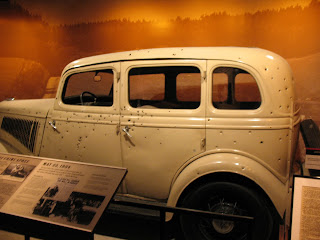
The film "Bonnie and Clyde" depicts the story of Bonnie Parker and Clyde Barrow. It won two Academy Awards (Best Actress in a Supporting Role - Estelle Parsons [Blanche Barrow] and Best Cinematography) and was nominated for eight more, including Best Actor in a Leading Role (Warren Beatty - Clyde Barrow), Best Actress in a Leading Role (Faye Dunaway - Bonnie Parker), Best Actor in a Supporting Role (Gene Hackman - Buck Barrow), Best Director (Arthur Penn) and Best Picture. It also won two BAFTA Awards (U.K.), one Bodil Award (Denmark), one David di Donatello Award (Italy), two Laurel Awards (USA), two Kinema Junpo Awards (Japan), one National Society of Film Critics' Award (USA), and one Kansas City Film Critics' Circle Award (USA). It was inducted into the National Film Registry in 1992. The car used at the end of the film (where they are ambushed) is currently housed in the National Museum for Crime and Punishment in Washington, D.C.


The Film: The movie was made in 1967, and the acting and effects make that clear. However, the story is one of legends, and transcends any "cheesiness" due to the age of the film. Unlike films of the current age - and something that, in my opinion, many films nowadays are severely lacking - "Bonnie and Clyde" tells the story of the people, not just the crimes. While there are several "shoot-em-up" scenes, there are also scenes that tell of Bonnie's immense loneliness and Clyde's desperation to be someone worthwhile. It brings the humanity of people to the forefront rather than relying on special effects and drawn-out action scenes to bring people to the theater.

The History: Historically, it is unknown exactly how they met, though most reputable stories imply it was through mutual friends. Bonnie Parker was a waitress in Cement City, Texas (a suburb of Dallas). She had married a high school sweetheart when she was 16, but they parted ways three years later in 1929. She met Clyde Barrow in January 1920. Clyde Barrow was born in Ellis County, Texas, just south of Dallas. He had several brushes with the law for offenses such as stealing cars, cracking safes, and stealing (his first real arrest was for stealing turkeys with his brother, Buck).

Bonnie and Clyde's criminal spree lasted from 1930 until their ambush in 1934. During that time they picked up Barrow family friend D. W. Jones as an accomplice (who also served as a sort of Judas of the group, giving up information to law enforcement that would later be used against the Barrow gang in the grand jury) and Clyde's brother Buck and his wife Blanche. The gang committed several murders, kidnappings, robberies, and car thefts. Bonnie and Clyde were ambushed by a posse of Texas Rangers and Louisiana law enforcement officers on May 23, 1934 in Bienville Parish, Louisiana.

The real Bonnie Parker and Clyde Barrow

Criminal Justice History: The story of Bonnie and Clyde is one of several in the "Public Enemy Era" of criminal justice. This is the same era that brought such legends as John Dillinger and Baby Face Nelson. One historian notes that Bonnie and Clyde would not have been famous had it not been for the infamous Joplin (MO) photographs depicting their arsenal of weapons and Bonnie's sex appeal. Bonnie and Clyde, like many Public Enemies, took advantage of the pre-FBI rule that law enforcement officers cannot cross state lines. As such, criminals could move from state to state without worry of being captured by another state's law enforcement. The formation of the FBI (and the institution of a federal law that made bank robbery and kidnapping federal offenses, and thus the jurisdiction of the FBI) brought the Public Enemy Era to an end. In fact, both John Dillinger and Baby Face Nelson were shot and killed mere months after the ambush of Bonnie and Clyde.

During their criminal spree, Bonnie Parker wrote several poems. One, entitled "The Story of Bonnie and Clyde," can be found here.